During a recent UAP (United Architects of the Philippines) convention, a telling conversation unfolded. A contractor specialized in wall repairs shared that a major portion of his business comes from fixing cracked walls built with alternative “lightweight” wall products. His frequent clients constantly require repairs because their newly installed walls keep developing severe structural cracks.
The verdict? “It’s not real AAC if it keeps cracking—it’s under-cured.”
Real AAC isn’t just mixed and air-dried like standard concrete—it is chemically transformed inside a high-pressure industrial autoclave. To produce genuine Autoclaved Aerated Concrete (AAC), the raw materials must undergo intense hydrothermal curing at 180°C to 195°C under a steam pressure of 10 to 12 bar (145 to 174 psi).
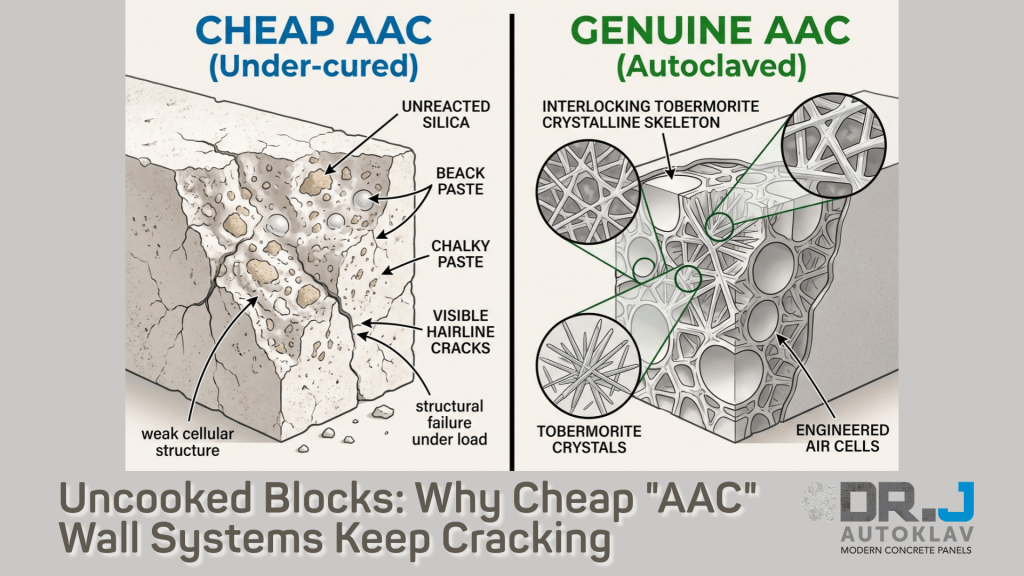
This extreme heat and pressure force quartz sand, lime, and cement to fuse, forming a microscopic, crystalline calcium silicate hydrate known as Tobermorite.
Because an AAC block consists of 80% engineered air cells, it relies entirely on this interlocking, needle-like tobermorite crystal skeleton for structural strength.
When substandard manufacturers bypass proper calibration or cut steam cycles short to save on fuel costs, tobermorite fails to form. The silica stays unreacted, leaving behind a weak, chalky paste holding air bubbles together.
While these under-cured blocks look identical to genuine AAC on the delivery truck, their structural strength is compromised. The moment structural loads or ambient movements occur, the weak cell walls crumble, leading to continuous, unsightly wall cracks. Choose genuine, properly cured wall partition systems to protect your structures from day one.
For more information about Dr.J Autoklav AAC, contact Europhil Advanced Material & New Technology Inc. at 8/Flr. Metrobank Plaza Bldg. Osmeña Blvd. Cebu City. Sales Admin: 09177053087, Sales Engineer: 0917 785 4987, 0961 629 4693, Sales Staff: 0962 816 1092, 0946 355 5501. Email: info@drj-autoklav.com
 Dr.J AAC
Leave a comment