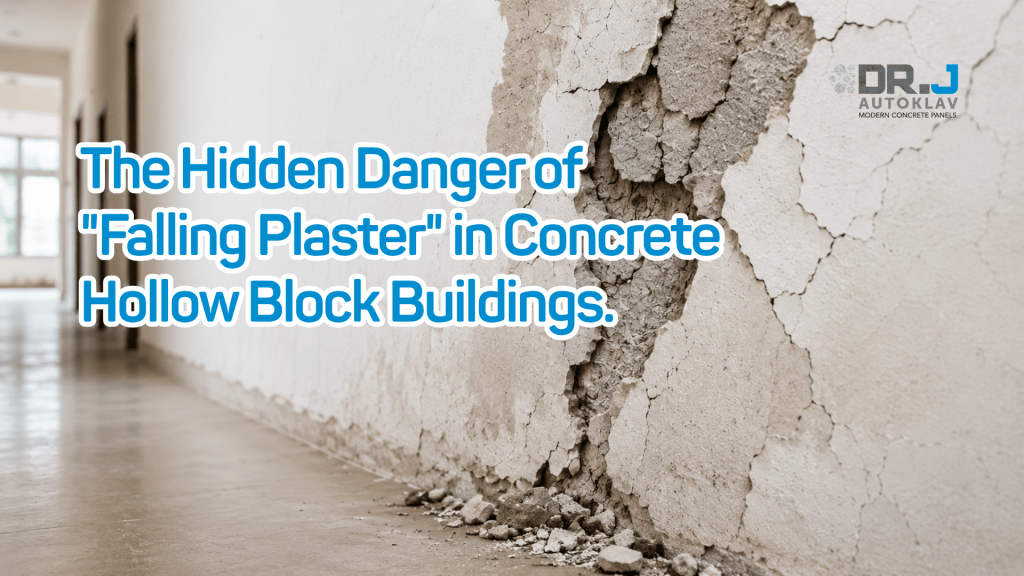
If you walk through a standard concrete hollow block (CHB) building, you will likely spot long horizontal cracks or thick slabs of peeling plaster. In engineering, this is known as plaster delamination—a failure where the wall’s outer skin detaches from its inner skeleton. This isn’t just an eyesore; it is a serious, immediate safety hazard for the building occupants.
Plaster fails primarily due to two invisible construction flaws:
- Water Starvation (Mechanical Bond Failure): Thirsty CHB blocks act like dry sponges. When workers apply wet plaster without soaking the blocks first, the hollow block instantly sucks out the moisture. Starved of water, the plaster dries out instead of chemically curing, leaving a fragile, hidden air gap behind the wall.
- The Sun Tug-of-War (Thermal Shock): The daily solar cycle creates a violent game of tug-of-war. The outer plaster absorbs heat, expands, and pulls away, while the insulated air pockets inside the hollow blocks keep the back cool and static. This severe shearing stress constantly snaps the plaster skin off the block.
Because hollow blocks are naturally uneven, plaster render is often slapped on up to 25mm thick. When gravity takes over, these heavy, solid cement chunks drop without warning—acting like falling guillotines that can cause severe head injuries or concussions in crowded corridors of commercial, office and school buildings.
Furthermore, rainwater seeps into these hidden air gaps, reaching the interior rebar. The rusting steel expands up to 6 times its size, causing destructive structural spalling from within, while the dark, unventilated cavity becomes a breeding ground for toxic black mold that triggers chronic asthma in people.
The Dr.J Autoklav Solution. Dr.J Autoklav Autoclaved Aerated Concrete (AAC) panels and blocks eliminate plaster delamination entirely. Engineered with uniform precision, they do not require thick, heavy plaster coats. The consistent material properties remove thermal shock failure, ensuring pristine, safe, and structurally sound walls for educational institutions that stand the test of time.
When you compare Dr.J Autoklav Autoclaved Aerated Concrete (AAC) panels directly to conventional CHB, the choice becomes clear:
- Weight Reduction: Dr.J AAC is up to one-third the weight of standard CHB, dramatically slashing the building’s overall dead load.
- Superior Insulation: Unlike porous, heat-retaining CHB, AAC offers exceptional thermal insulation, keeping interiors cooler and reducing long-term energy costs.
Switching to a modern, locally manufactured solution pays off. Inquire with Dr.J Autoklav today to request technical specifications and discover how switching from CHB to high-performance AAC panels can elevate your structural design.
For more information about Dr.J Autoklav AAC contact Europhil Advanced Material & New Technology Inc. at 8Flr. Metrobank Plaza Bldg. Osmeña Blvd. Cebu City. Sales Admin: 09177053087, Sales Engineer: 0917 785 4987, 0961 629 4693, Sales Staff: 0962 816 1092, 0946 355 5501. Email: info@drj-autoklav.com
 Dr.J AAC
Leave a comment