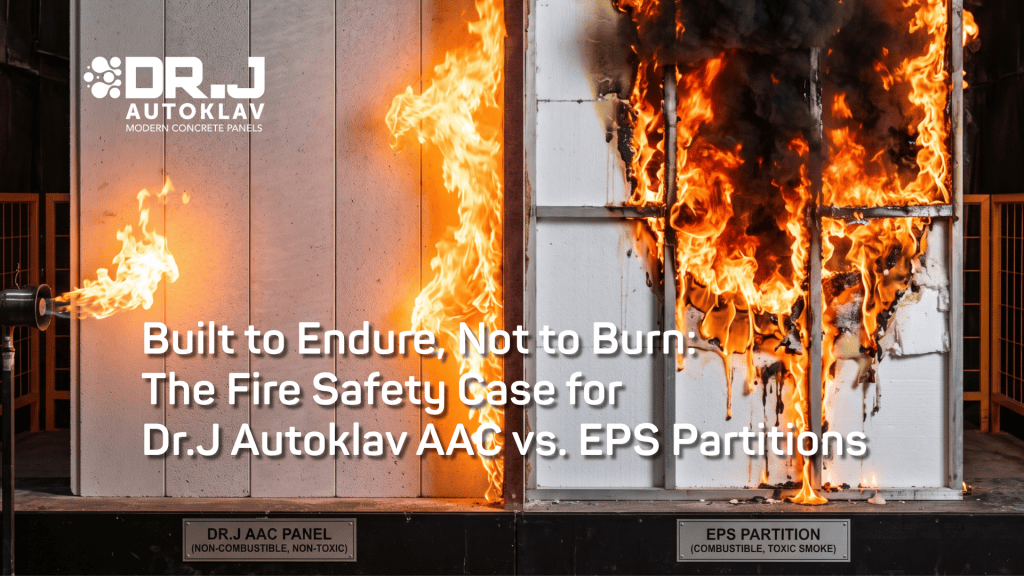
The distinction between modern building materials and legacy insulation products can be the difference between a minor incident and a catastrophic loss. Throughout global construction history, over 40 major high-profile structure fires have been traced directly to expanded polystyrene (EPS), extruded polystyrene (XPS), and poly-foam sandwich panels acting as primary fuel sources. From the fatal 2025 Wang Fuk Court fire in Hong Kong to cold storage disasters like the Hanwoo facility in South Korea, combustible lightweight partitions have repeatedly demonstrated how quickly polymer foam can liquefy, release toxic smoke, and fuel vertical flashovers.
For property developers, contractors, and architects seeking total structural protection, Dr.J Autoklav AAC (Autoclaved Aerated Concrete) panels and blocks offer an uncompromised, non-combustible alternative.
The Physics of Safety: AAC vs. EPS
When exposed to extreme heat, EPS and polystyrene partitions deteriorate rapidly. Polystyrene is essentially solidified petroleum; at temperatures as low as 100°C (212°F), it begins to melt, releasing dense, highly hazardous styrene gas and creating toxic, dripping “pool fires” within wall cavities. Metal-skinned EPS sandwich panels frequently fail during structural fires because the core ignites inside the steel cladding, leading to sudden delamination and wall collapse.
In stark contrast, Dr.J Autoklav AAC is a 100% inorganic, cellular concrete material composed of quartz sand, lime, cement, water, and an expanding agent. Cured under high-pressure steam in an autoclave, its porous crystalline structure delivers exceptional thermal performance without relying on flammable polymers.
| Fire & Structural Property | EPS / Polystyrene Partitions | Dr.J Autoklav AAC |
| Combustibility Class | Combustible / Flammable (Euroclass E/F) | Non-Combustible (Euroclass A1) |
| Fire Resistance Rating | Minimal without thick drywall protection | Up to 4 Hours (100mm–150mm thick) |
| Toxic Smoke / Off-Gassing | Heavy black smoke, toxic carbon monoxide & styrene | Zero smoke generation, non-toxic |
| Melting Point / Behavior | Melts & liquefies at ~100°C; fuels flame spread | Does not melt; withstands up to 1,200°C |
| Structural Integrity in Fire | Rapid core degradation; prone to sudden collapse | Maintains load-bearing capacity under extreme heat |
Unmatched Thermal Efficiency Without the Hazard
While traditional builders could consider EPS partitions for lightweight thermal resistance, AAC delivers superior thermal insulation while serving as an active fire wall. A standard 100mm Dr.J Autoklav AAC panel easily achieves a 4-hour fire-resistance rating, preventing fire transmission between rooms or adjacent buildings.
Whether designing high-rise commercial towers, residential complexes, cold storage environments, or institutional facilities, switching to Dr.J Autoklav AAC blocks and panels eliminates toxic smoke risks, prevents rapid external flame spread, and ensures compliance with strict international fire safety standards. Protect your investment and save lives by building with non-combustible autoclaved aerated concrete.
For more information about Dr.J Autoklav AAC contact Europhil Advanced Material & New Technology Inc. at 8Flr. Metrobank Plaza Bldg. Osmeña Blvd. Cebu City. Sales Admin: 09177053087, Sales Engineer: 0917 785 4987, 0961 629 4693, Sales Staff: 0962 816 1092, 0946 355 5501. Email: info@drj-autoklav.com
 Dr.J AAC
Leave a comment