In the wake of the recent earthquake in Mindanao, the construction industry is facing critical questions about building longevity. When designing for seismic zones, many traditionally believe that “heavy and thick” equals “strong.” However, structural engineering tells a completely different story.
To build structures that protect lives, we must understand the relationship between a building’s weight and the forces that try to tear it down.
Heavy vs. Lightweight Materials: The Battle of “Dead Load”
In engineering, dead load refers to the permanent, static weight of the building components themselves—the beams, columns, floors, and walls.
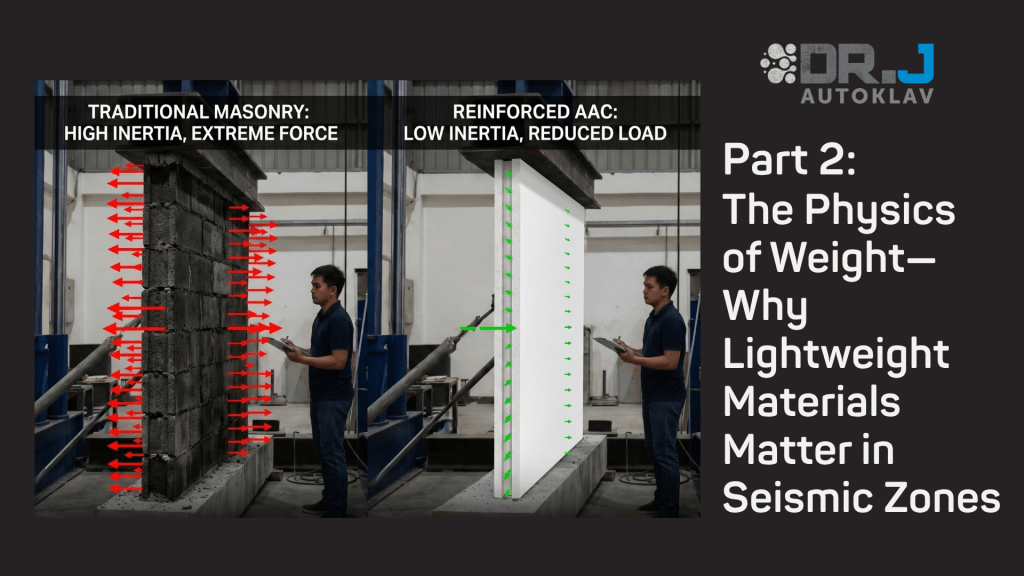
During an earthquake, ground acceleration creates inertial forces. Simply put: forces increase with building weight. When a heavy, traditional masonry building shakes, its own mass acts against it, creating massive stress on the structural frame.
By substituting traditional concrete blocks with lightweight alternatives, you drastically reduce the dead load. Less mass means less kinetic energy tearing at the building’s joints, resulting in superior performance in seismic regions.
The Technical Advantage of Dr.J Autoklav AAC Panels
For contractors and engineers, AAC panels (Autoclaved Aerated Concrete) offer a sophisticated solution to this physics problem.
- Steel-Reinforced Core: Modern AAC panels are not just lightweight; they are embedded with corrosion-protected steel reinforcement mesh, giving them the tensile strength necessary to flex slightly without catastrophic failure.
- Reduced Dead Load: AAC panels are roughly one-third the weight of traditional concrete, drastically lowering the building’s lateral seismic forces.
- Fast and Precise Installation: Beyond safety, the lightweight nature of these large panels allows for rapid, precise installation, reducing labor time while ensuring tight, consistent joints that perform predictably under stress.
After the Shaking Stops: Signs Your Building Needs an Inspection
Being a responsible property owner or contractor means knowing how to evaluate a structure post-earthquake. While some settling is normal, certain warning signs demand an immediate assessment by a structural engineer:
- New, Deep Wall Cracks: Look for diagonal cracks (especially 45-degree angles) near wall openings, which indicate shear stress.
- Separation at Structural Junctions: Gaps forming between walls and columns or beams mean the building’s components are pulling apart.
- Uneven or Sloping Floors: This can indicate foundation shifts or compromised load-bearing elements.
- Sticking Doors and Windows: If frames suddenly warp and doors no longer close smoothly, the building’s frame may have shifted out of alignment.
When to call a professional: If you notice any structural separation or deep cracking, restrict access to the area and contact a licensed structural engineer immediately.
In our final installment, Part 3, we will look at the blueprint stage—discussing how earthquake preparedness starts on the drawing board long before construction ever begins.
For more information about Dr.J Autoklav AAC contact Europhil Advanced Material & New Technology Inc. at 8Flr. Metrobank Plaza Bldg. Osmeña Blvd. Cebu City. Sales Admin: 09177053087, Sales Engineer: 0917 785 4987, 0961 629 4693, Sales Staff: 0962 816 1092, 0946 355 5501. Email: info@drj-autoklav.com


Leave a Reply