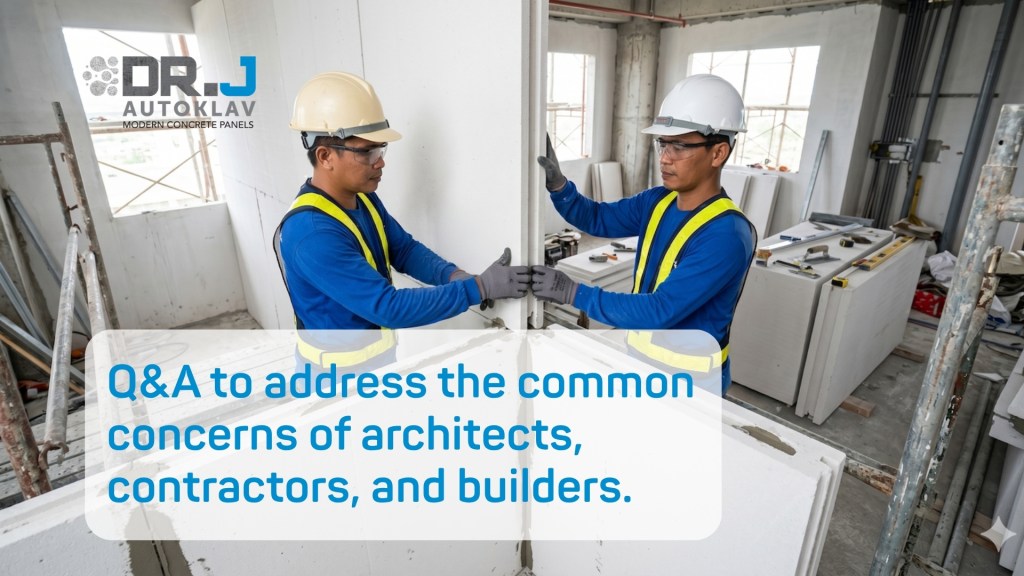
RE: The Total System Advantage & Cost-Effectiveness
Q1: Dr.J AAC panels seem more expensive than traditional Concrete Hollow Blocks (CHB) or other lightweight solutions. How can you say this system saves money?
A: When considering construction costs, it’s essential to evaluate the Total System Cost, not just the purchase price of a single block. While the initial material cost of Dr.J Autoklav may be higher than CHB, the system reduces total expenses by 15% to 20%. These savings are realized through:
- Lower Labor and Time Costs: The speed of construction is 2x to 3x faster than traditional methods, drastically reducing labor days.
- Reduced Structural and Foundation Loads: Because AAC is up to 80% lighter than CHB, it lowers the dead load on the structure, allowing for smaller structural components (steel frames and concrete) and a less intensive, less expensive foundation.
- Lower Material and Finishing Costs: AAC requires only 3.2mm of specialized thin-bed adhesive mortar, compared to thick traditional mortar. High dimensional accuracy also means a very thin plaster or skimcoat is needed, saving on finishing labor and materials.
- Significant Transportation Savings: Lightweight materials allow for more volume per delivery truck, cutting transportation costs by 30-40%.
- Long-Term Operational Savings: The inherent thermal insulation can reduce HVAC energy consumption by up to 25-30%.
RE: Fire, Seismic, and Hazardous Protection
Q2: Is your partition wall a fire hazard, or just “fire-retardant”?
A: Many modern lightweight partitions rely on foam cores that are merely “fire-retardant,” meaning they are treated with chemicals to slow ignition. They are still inherently combustible and melt or fuel a fire once the threshold is exceeded.
Dr.J Autoklav AAC is purely mineral-based, non-combustible material. It contains no flammable glues or organic fillers. It has a Fire Rating of 4 Hours and can withstand temperatures up to 1,200°C for 4 to 6 hours (depending on thickness). Crucially, during a fire, AAC does not produce toxic fumes, addressing the silent killer in high-rise environments.
Q3: In the Philippines, we worry about “The Big One.” How can a lightweight wall save structures in earthquakes?
A: During an earthquake, the destructive force hitting a building is directly proportional to its mass. By switching to lightweight Dr.J Autoklav (up to 80% lighter than traditional masonry), you reduce the dead load. This lower mass reduces the destructive inertial forces hitting the building.
Furthermore, the Tongue and Groove interlocking design keeps partitions stable and prevents them from collapsing or “popping out” during the swaying of the building frame. AAC also provides better ductility, moving with the steel frame rather than resisting it.
Q4: Is AAC truly “hazard-proof”?
A: Yes, for construction in the Philippines, resilience is key. In addition to being fire-resistant and seismic-load reducing, Dr.J Autoklav AAC is engineered to be moisture, pest, and termite resistant. It won’t rot or warp like non-mineral alternatives, safeguarding your investment for decades.
For more information about Dr.J Autoklav AAC contact Europhil Advanced Material & New Technology Inc. at 8th Flr. Metrobank Plaza Bldg. Osmeña Blvd., Cebu City. Sales Admin: 09177053087, Sales Engineer: 0917 785 4987, 0961 629 4693, Sales Staff: 0962 816 1092, 0946 355 5501. Email: info@drj-autoklav.com


Leave a Reply