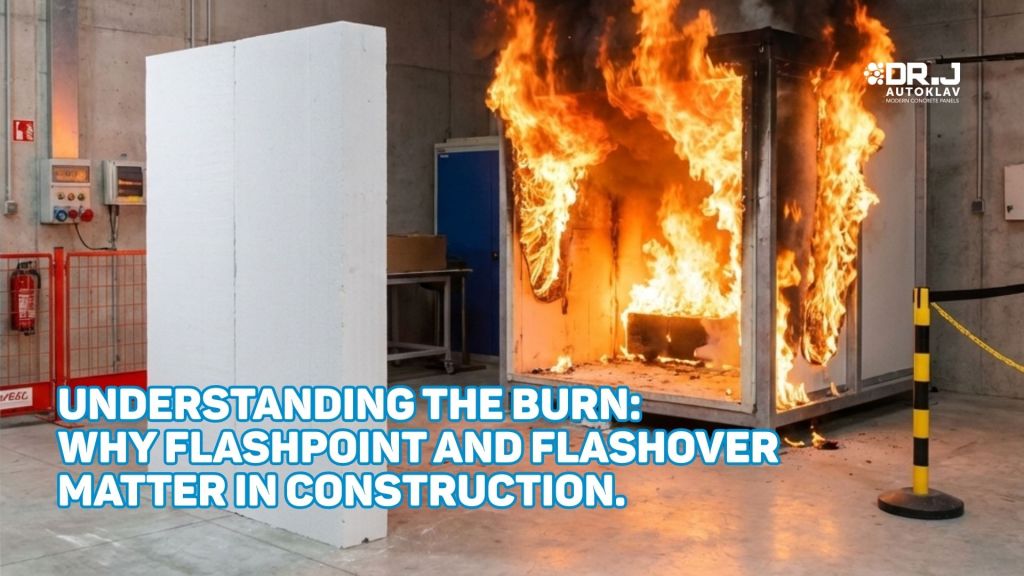
In fire safety, two terms define the difference between a controllable incident and a catastrophe: Flashpoint and Flashover. Understanding the relationship between these two is essential when choosing between building materials like Autoclaved Aerated Concrete (AAC) and petroleum-based alternatives like Expanded Polystyrene (EPS) or sound proofing acoustic egg-crate foams.
Flashpoint: The Spark of Ignition
A Flashpoint is a material property. It is the lowest temperature at which a substance gives off enough vapor to ignite briefly when exposed to a flame.
- EPS (Styrofoam): As a petroleum-based plastic, EPS is combustible. It begins to soften at just 100°C and has a flashpoint for its released gases at approximately 360°C. When it reaches this point, it doesn’t just sit there; it melts, drips, and provides a “fuel load” that can sustain a fire.
- AAC: Because it is a purely mineral-based material (made of sand, lime, and cement), AAC is non-combustible. It has no flashpoint. It does not produce flammable vapors, meaning it cannot contribute to the initial ignition of a fire.
Flashover: The Point of No Return
While flashpoint is about a single material, Flashover is a catastrophic room-wide event. It occurs when the heat in a confined space reaches such an intensity (typically 500°C to 600°C) that every flammable surface in the room ignites simultaneously. In a flashover, a small localized fire transforms into an all-consuming inferno in seconds, making the environment unsurvivable.
The Danger of Combustible Partitions
Materials like EPS sandwich panels and polyurethane egg crate foams are inherently hazardous because they possess relatively low flashpoints. When exposed to heat, EPS begins to melt and decompose, releasing flammable vapors and toxic gases. These vapors act as fuel, rapidly increasing the thermal energy in a room and significantly accelerating the timeline to a deadly flashover. In a fire, these materials don’t just sit there; they actively contribute to the “all-consuming” fire event.
The AAC Advantage: No Fuel, No Flashpoint
Autoclaved Aerated Concrete (AAC) changes the physics of fire safety entirely because it is non-combustible. Unlike EPS, AAC is a mineral-based material—it has no flashpoint. It does not ignite, it does not melt, and it does not release flammable vapors.
AAC acts as a thermal barrier. Its cellular structure and low thermal conductivity significantly slow down heat transfer. Because AAC can withstand temperatures up to 1,200°C without burning or losing structural integrity, it helps prevent a room from reaching the flashover stage. Even if a fire is raging on one side, an AAC wall can keep the other side cool enough to allow for a safe evacuation for up to four hours or more.
By choosing AAC, you are not just selecting a partition; you are installing a permanent defense that denies a fire the fuel it needs to become an inferno. When safety is paramount, AAC is the smart choice for wall partitions.
 Dr.J AAC
Leave a comment