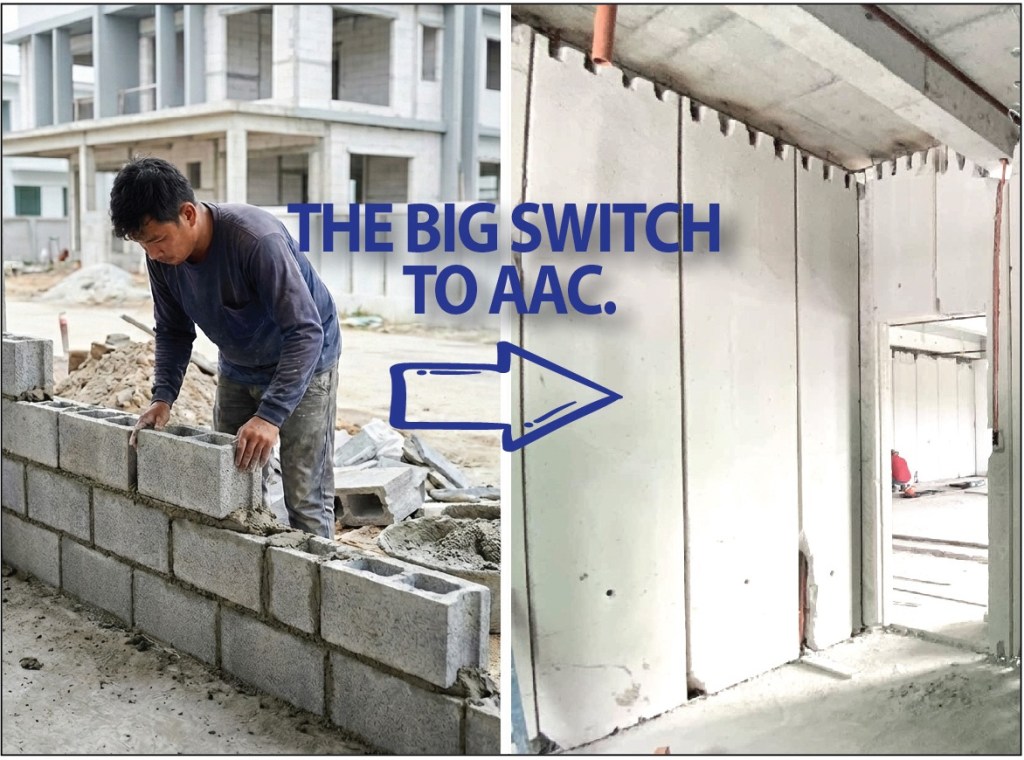
Shifting from traditional construction materials to Autoclaved Aerated Concrete (AAC) is a significant decision for architects, contractors, and property owners. While the benefits are immense, skepticism is natural.
Here are the four most critical questions potential customers ask, and the answers that prove why AAC is the superior choice for modern construction.
1. “It looks lightweight. Is AAC actually strong enough for my project?” Absolutely. Do not mistake lightness for weakness. AAC is a structural, load-bearing material. Its cellular structure provides substantial compressive strength. More importantly, its reduced weight is a massive advantage: it lowers the building’s dead load, significantly improving seismic performance during earthquakes compared to heavy, brittle traditional concrete blocks.
2. “Isn’t AAC more expensive than traditional hollow blocks?” If you only compare the price per block, yes. If you compare total project cost, no. AAC saves money by drastically reducing other costs. Its precise dimensions require only a thin-bed adhesive (2-3mm) instead of thick, expensive mortar. Furthermore, its speed reduces construction labor hours by up to 4X less, and its light weight can reduce the steel reinforcement needed in the main structure.
3. “How does AAC actually speed up construction?” AAC blocks are larger and lighter than traditional materials, meaning crews cover more square footage in less time with less fatigue. Furthermore, AAC is incredibly workable; it can be easily cut, drilled, and chased for electrical and plumbing lines using standard tools, accelerating the mechanical, electrical, and plumbing (MEP) phases significantly. Construction labor hours and cost is reduced by up to 4X less.
4. “Why is AAC considered safer and more comfortable?” AAC is a 2-in-1 solution. First, it is non-combustible, offering 4 to 6-hour fire rating—a level of safety other lightweight materials such as Expanded Polystyrene (EPS) or “Styrofoam” sandwich panels cannot match. Second, its thermal insulation properties are superior, keeping interiors cooler and drastically lowering long-term energy bills for air conditioning.
When considering these key questions, it’s clear that switching to AAC is the better choice for your next construction project.
 Dr.J AAC
Leave a comment