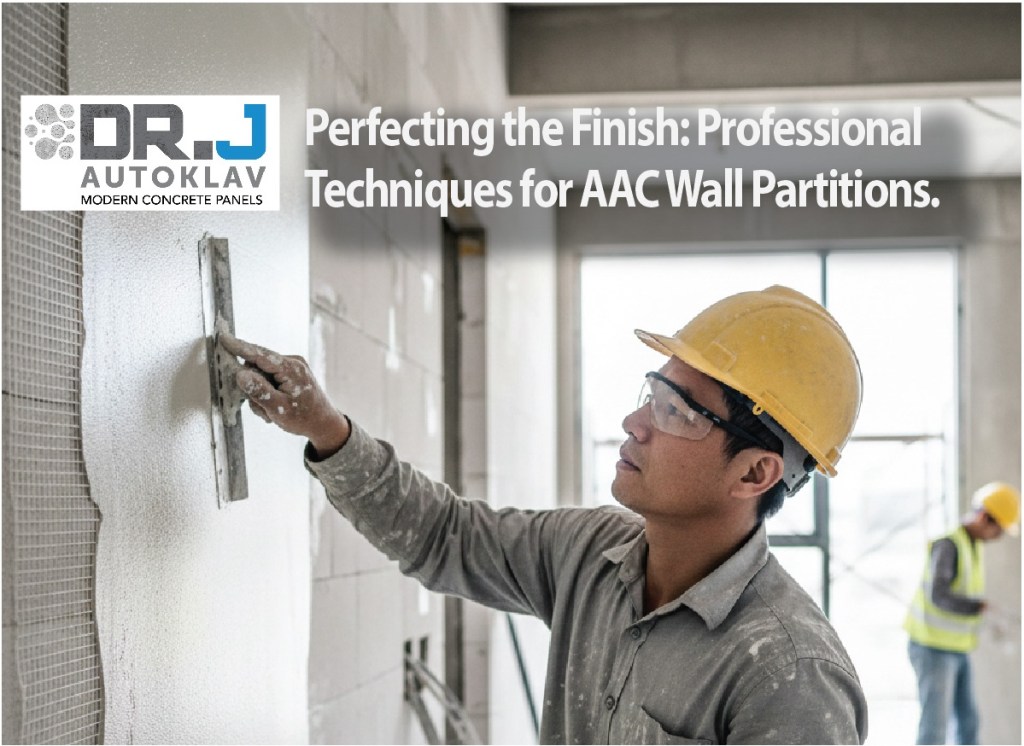
While the precision of Autoclaved Aerated Concrete (AAC) provides a superior head start, the quality of the final wall depends on specific finishing techniques. Using the right materials ensures your partitions are not only structurally sound but also crack-resistant and aesthetically flawless.
1. Reinforcing with Corner Beads
AAC corner beads are products designed to provide strength, protection, and a clean, straight finish to the corners of walls built with AAC blocks or panels. Corner beads (metal or vinyl) are essential for creating sharp, impact-resistant edges. They act as a guide for plaster depth and protect corners from chipping.
- Corner Protection: They act as a shield for the vulnerable edges of AAC walls from everyday impacts.
- Aesthetics: Corner beads help create sharp, uniform, and professional-looking edges, essential for a high-quality finish.
- Ease of Installation: They simplify the plastering process by providing a consistent guide for material thickness and edge alignment, saving time and labor.
- Durability: Using appropriate corner beads enhances the structural integrity of the corner, preventing issues like hairline cracks.
2. AAC Finishing Mesh
The mesh refers to alkali-resistant fiberglass mesh that is embedded into the base coat of render or plaster applied over AAC walls. This mesh is a crucial component designed to provide tensile strength, enhance crack resistance, and ensure the long-term integrity of the finish. The primary purpose of using a finishing mesh with AAC is to accommodate the minor movements and thermal expansion/contraction of the concrete substrate, which helps prevent surface imperfections and common settlement cracks.
To prevent surface cracks—especially at the joints between panels or where AAC meets concrete columns—fiberglass mesh should be embedded into the first layer of plaster or skimcoat.
- Crack Resistance: The fiberglass mesh provides engineered reinforcement that dissipates stress, significantly reducing the risk of cracking in the final plaster or render finish.
- Durability: It creates a more robust and durable surface that is resistant to impact and weathering.
- Alkali Resistance: The mesh must be alkali-resistant (AR) because the cement-based renders used with AAC are alkaline. Standard fiberglass mesh would degrade over time in this environment.
- Aesthetic Finish: By reinforcing the base coat, the mesh helps achieve a high-quality, smooth, or textured decorative finish that hides surface imperfections and the alignment variations inherent in wall construction.
3. AAC Precise Wall Chasing (Cutting Grooves) and Patching
AAC’s workability makes wall chasing using a specialized wall groove cutter (chaser) for precise, uniform channels for electrical and plumbing lines incredibly efficient. Planning is the most important step in chasing AAC walls. All electrical and plumbing routes should be planned before the walls are built, if possible, to avoid weakening the structure.
- Tool: Use a specialized wall groove cutter (chaser) for precise, uniform channels. Avoid random or overly deep cutting, which can seriously diminish the wall’s integrity.
- Depth Limits: Chases should generally not exceed one-third of the wall’s thickness for vertical runs and one-sixth for horizontal runs.
Once utilities are installed, the “groove” must be filled with a high-strength repair mortar rather than standard cement. The patching process is filling grooves and defects on the AAC using AAC mortar to ensure the patch bonds perfectly and doesn’t shrink or crack over time.
4. Surface Preparation and Skim Coating
Because AAC is porous, it can quickly suck moisture out of plaster, leading to “map cracking.” Applying a bonding agent or primer before finishing helps regulate water absorption. For the final finish, a high-quality skimcoat is applied in thin layers. This results in a “mirror-smooth” surface that requires minimal sanding and significantly less paint than traditional concrete hollow blocks.
By integrating these professional finishing touches, builders ensure that the speed and efficiency of AAC construction are matched by a high-end, durable finish that stands the test of time.
For more information about Dr.J AutoklavAAC contact Europhil Advanced Material & New Technology Inc. at 8Flr. Metrobank Plaza Bldg. Osmeña Blvd. Cebu City, +63997-216-0800, +63946-355-5501 or Unit 1717, Cityland 10 Tower 1, 154 H.V. Dela Costa, Makati, Metro Manila, Philippines. +63 920 983 1106
 Dr.J AAC
Leave a comment