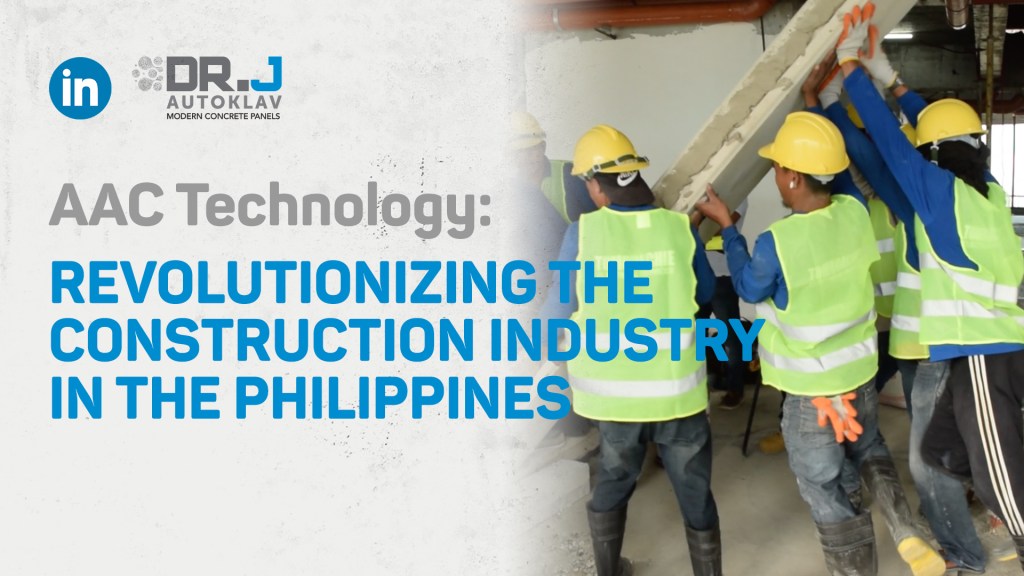
Autoclaved Aerated Concrete (AAC) technology is reshaping the construction landscape, offering a sustainable, efficient, and innovative approach to building. This lightweight, precast concrete material has rapidly gained popularity due to its exceptional properties and environmental benefits.
A Brief History of AAC
The origins of AAC (autoclaved aerated concrete) can be traced back to the early 20th century when Swedish scientist Axel Eriksson developed the initial concept. However, it wasn’t until the mid-20th century that AAC gained significant traction and commercialization began. The material’s unique properties, such as its excellent thermal insulation, fire resistance, and soundproofing, quickly made it a desirable choice for construction.
AAC was recently introduced In the Philippines and its acceptance has been strong. Among the leading manufacturers of AAC panels and blocks in the country is Dr.J Autoklav with a purpose-built 3.5hectare facility in Cebu.
The Innovative Edge of AAC (autoclaved aerated concrete)
- Lightweight and High Strength: AAC blocks are significantly lighter than traditional concrete blocks without compromising strength. This characteristic reduces the structural load on buildings, allowing for faster construction and cost savings.
- Excellent Fire Resistance: AAC blocks are inherently fire-resistant, providing crucial protection for occupants and property.
- Disaster Resistant Construction: AAC’s high strength-to-weight ratio can withstand seismic activity, high winds, and other extreme weather conditions. Additionally, AAC’s fire resistance is a critical factor in disaster resilience.
- Superior Thermal Insulation: AAC’s closed-cell structure provides exceptional thermal insulation, reducing energy consumption for cooling. This contributes to lower power consumption, HVAC utility bills and a smaller environmental footprint.
- Soundproofing: The material effectively absorbs sound, creating quieter and more comfortable living and working spaces.
- Sustainability: AAC production processes often utilize recycled materials and consume less energy compared to traditional concrete production. Additionally, the material is highly recyclable at the end of its lifespan.
Ongoing Research and Development
The construction industry is continually exploring new applications and improvements for AAC (autoclaved aerated concrete) technology. Researchers are focused on enhancing the material’s properties, expanding its use beyond traditional wall construction, such as precast components, flooring, and roofing systems and developing more sustainable production methods.
Pushing the Boundaries of Construction
AAC (autoclaved aerated concrete) technology is driving innovation in the construction industry by offering a versatile and sustainable solution. Its ability to reduce construction time, improve energy efficiency, and enhance building performance is transforming the way we build. As research and development continue to advance, AAC is poised to play an even more significant role in shaping the future of sustainable and efficient construction.
By embracing AAC technology, the construction industry can contribute to a more sustainable built environment while delivering high-quality, durable, and comfortable buildings.
For more information about how AAC can be a modern solution to your construction needs contact Europhil Advanced Material & New Technology Inc. regarding Dr.J Autoklav AAC at 8Flr. Metrobank Plaza Bldg. Osmeña Blvd. Cebu City, Philippines or Unit 1717, Cityland 10 Tower 1, 154 H.V. Dela Costa, Makati, Metro Manila +63997-216-0800, +63946-355-5501 Email: info@DrJ-Autoklav.com
 Dr.J AAC
Leave a comment